Matthew Martin came to us to build a tool for his own nurseries. He always thought it could be a product too.
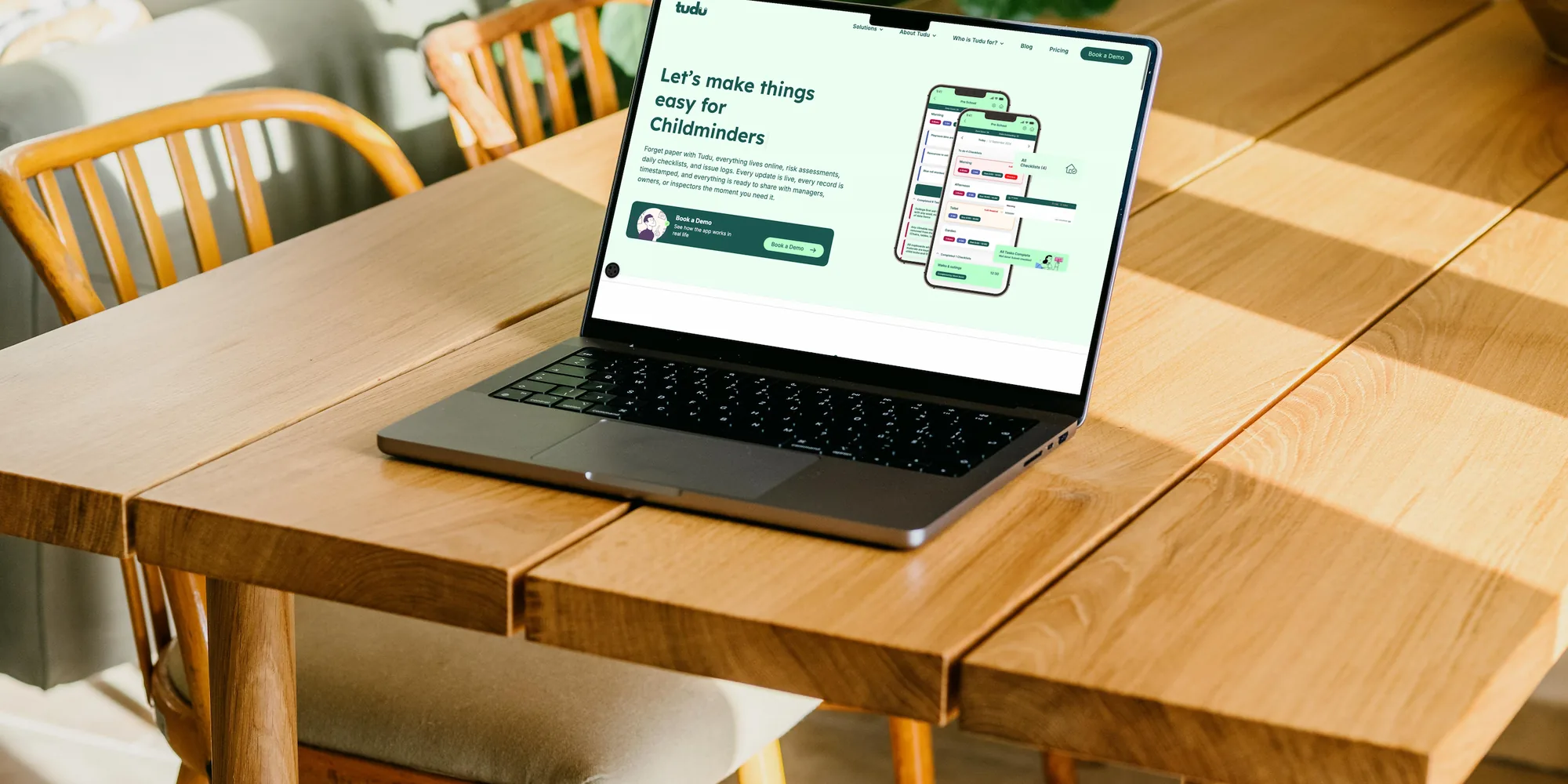
Tudu holds a childcare provider's paperwork in one place: risk assessments, daily checklists, quality checks and problem reports. Every entry records who did it and when, so you can show it to a manager, an owner or an inspector. It is now sold to childcare settings, activity clubs and childminders across the UK.
Matthew has spent over a decade in early years and runs Little Beehive, a group of nurseries. When he first came to us, he wanted his own paperwork off paper. But the product was in his head from the beginning: he could see other settings needing exactly the same thing.
We built all of it with him: the brand, the design, the apps, the platform and the website. This is the part that is more useful to anyone else sitting on an internal tool: what changed along the way, and what we would do again.
Paper, not software
Every childcare setting carries the same load. Risk assessments that have to stay current. Daily checklists for every room, every toilet, every garden and every outing. Problems that need logging and then chasing. Quality checks that have to be proved.
Paper fails twice. It will not tell you what has been done today, and it cannot prove what was done six months ago. Both failures land on the same person, usually a manager, usually at the wrong moment.
So the first job was not to draw screens. It was to understand how the day actually runs. What happens at 8am in a pre-school room, who does it, who checks it, and what happens when something is wrong. Get that right and the screens are the easy part.
The first version
A couple of years earlier we had built Matthew a rough Android app, wrapped around his own nursery. It was never meant to last. It was there to answer one question: would all this paperwork actually work on a phone, in a real room, with children about? It did.
So the job changed. Building for one nursery and building for thousands are not the same job, so we started the real thing from a clean sheet. That rebuild is where the product decisions got made. Each setting configures its own rooms, instead of Little Beehive's being fixed in the code. Different staff get different access. Every customer's data is kept separate, from day one.
Design decisions
The person filling in a Tudu checklist is not at a desk. They are on their feet, one hand free, with children in the room and something else already waiting. That shaped the app more than any styling did.
Big buttons. One thumb. A checklist you can finish in pieces between two other jobs, with a clear submit at the end. Risks and quality checks sit inside the jobs people already do, not in a separate section nobody opens. Because every entry is stamped with a name and a time, the record writes itself.
Managers get the other half: what is happening in every area, what is late, and a score they can act on. The record is a side effect, not an extra task.
The brand
There was no brand at the start. No logo, no colours, no sense of how it should sound. Our design team built all of it out of conversations with Matthew: the wordmark, the mint and deep green palette, the illustrations, the tone.
The brief was narrow. Warm enough for a nursery, credible enough to sell to a nursery group, and calm enough to use every morning.


How we worked
Matthew's vision mostly lived in his head. Getting it out, ordering it and sometimes arguing with it was a big part of the work.
Our developers did not just build the brief. They questioned it and often proposed something better. That can be uncomfortable, and it is why the product is good.
It would have been easy to simply build exactly what I asked for, but they cared too much about the product to do that. They challenged ideas, questioned assumptions and regularly suggested better ways of solving problems. Those discussions weren’t about making development easier, they were about building the best possible product.
Matthew Martin, Founder and Director, Tudu
It only works both ways. A team that pushes back needs a client who wants to be pushed back at. Matthew did, and it showed up in the product.
Your internal tool
Plenty of good products start as somebody's spreadsheet or somebody's workaround. If that is where you are, these are the questions worth answering before you spend anything.
Is the problem yours, or your whole sector's? Matthew's paperwork problem was every childcare provider's, which is what made it worth building. If yours is unusual, you have an internal tool, and that is fine.
Would anyone pay for it? Not "use it if it were free". A price gets you an honest answer.
Are you testing an idea or building a product? A rough version tells you cheaply whether the idea holds up. Do not expect to grow it into the real thing. Tudu's first build was thrown away once it had done its job.
Who holds it while you do your day job? Matthew was running nurseries. A product needs someone accountable every week: you, a hire or a partner.
Do you want a supplier or a team? A supplier builds what you asked for and invoices you. A team tells you when what you asked for is wrong.
It stopped feeling like a client-supplier relationship very quickly and instead felt like I had a team working alongside me.
Matthew Martin, Founder and Director, Tudu
Tudu now
Tudu sells to three markets from one platform, with its own website, pricing and demo booking. It is growing now rather than being built.
If you have an internal tool, a spreadsheet everyone depends on, or an idea still in your head, we would be glad to talk it through. Drop us a line at info@mtc.co.uk or call 0344 804 2021.